Commercial drywall repair, finished and painted by the same crew.
Commercial drywall repair for Utah offices, retail and warehouses. We cut out the damage, finish and texture-match the patch, prime it and paint it, so the wall reads as one surface again.
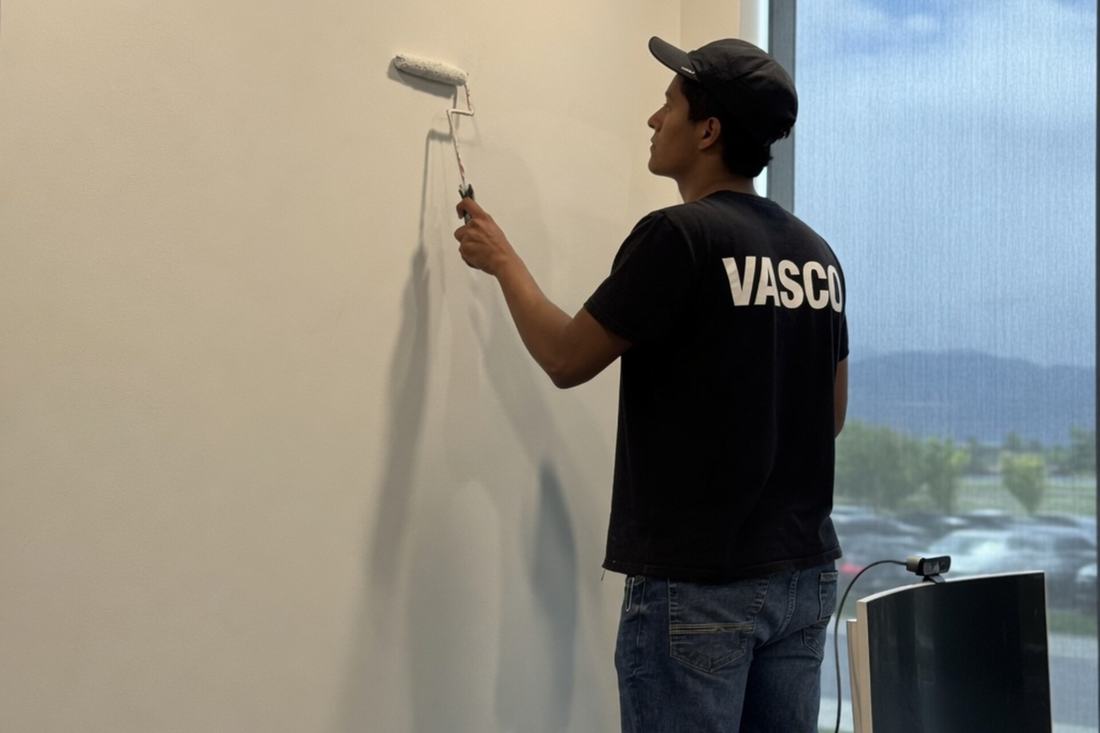
The damage we repair
Anchor holes
Screw and toggle holes left by TVs, whiteboards and shelving. Torn face paper is sealed before filling so the patch does not blister.
Furniture impact
Gouges at chair height, dents from desk corners and holes from a move. Broken board is cut back to solid gypsum and replaced.
Corner bead
Dented or cracked outside corners. We cut out the bent bead, set new bead and float both sides straight.
Water staining
After others fix the leak and the wall is dry, we replace soft board, seal the stain with stain-blocking primer and refinish.
Trade cut-outs
Access holes left by electricians and plumbers. We add backing, fit new board, tape the joints and finish flush.
Old patches that flash
Earlier repairs that show through the paint. We skim them wider, prime them and repaint.
Finish levels and where each belongs
Finish levels come from the Gypsum Association's GA-214 standard. They describe how far joints and fasteners are taken before paint, and a patch has to meet the level of the wall around it.
| Level | What it means | Where it belongs |
|---|---|---|
| Level 3 | Tape embedded, one more coat over joints, two coats over fasteners | Walls that get a medium or heavy texture, such as knockdown |
| Level 4 | Two more coats over taped flat joints, three over fasteners, sanded smooth | The office standard: flat or low-sheen paint and light textures |
| Level 5 | Level 4 plus a skim coat across the whole surface | Smooth walls under raking light, long corridors, deep colors and glossier sheens |
Our own crew finishes to Level 4 and Level 5.
Texture matching: orange peel, knockdown, smooth
A flat patch on a textured wall shows from across the room. We identify the existing texture and test the pattern before we spray the wall.
- Orange peel. Thinned compound sprayed in a fine splatter. The mix, the tip and the air pressure set the pattern size.
- Knockdown. A heavier splatter, left to set briefly, then flattened with a knockdown knife.
- Smooth. Nothing hides the repair, so we feather the patch wide and skim the area.
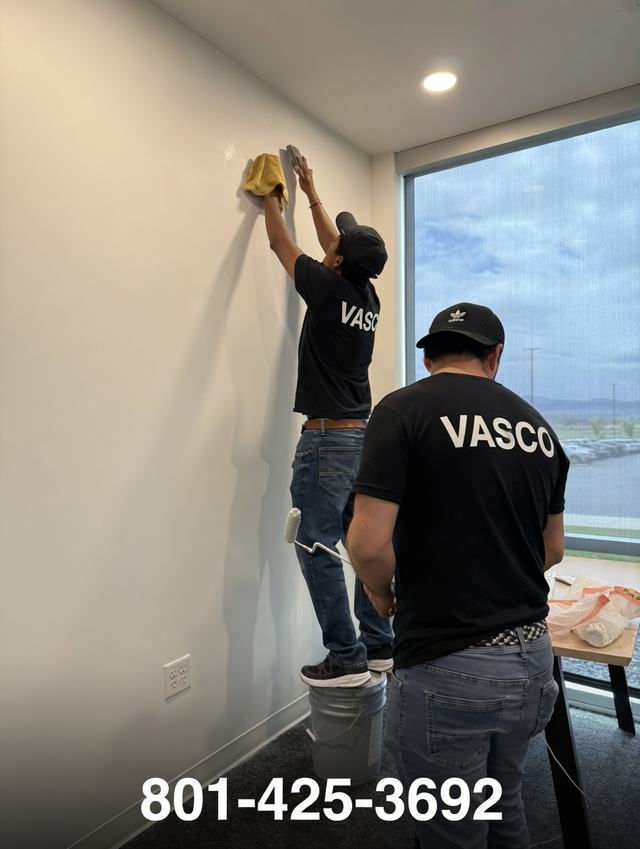
Why the same crew patches and paints
Joint compound absorbs paint differently than the painted wall around it. Skip the primer and the patch flashes: a dull or shiny halo that shows in afternoon light.
On our crew the finisher is also the painter. The person who floats the patch primes it, matches color and sheen, and paints to a corner where a touch-up would show.
You get one crew and one invoice, and nobody is left blaming another trade for a repair that shows.
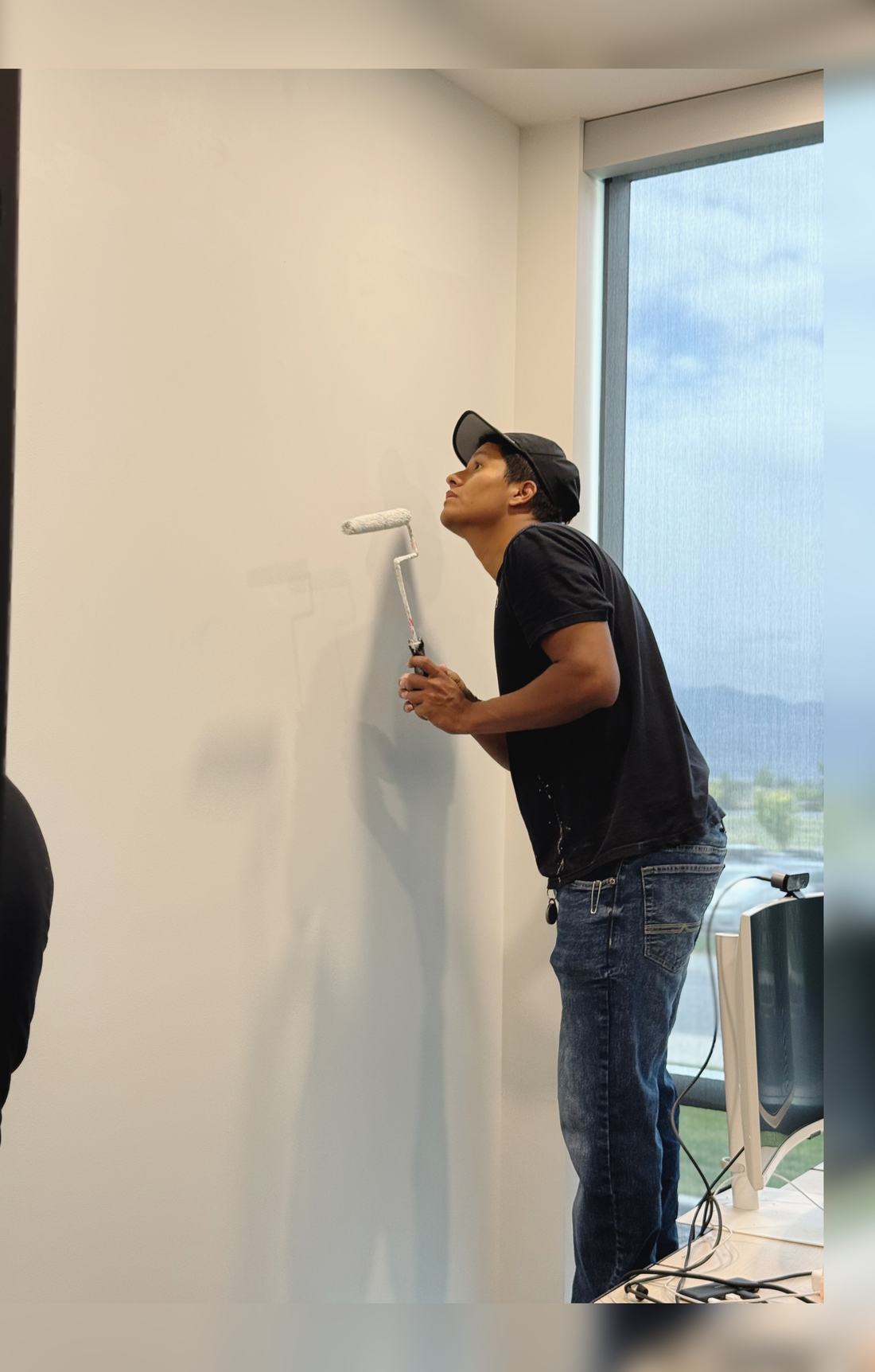
Dust control in occupied offices
Sanding is the dusty step, and in an occupied office it happens after hours. Four habits keep dust off desks and out of the carpet.
- Cover first. Floors, furniture and equipment near the repair are covered before we cut
- Close off larger repairs. Bigger work areas are separated with plastic sheeting
- Sand light. Small patches are wet-sanded or hand-sanded, and power sanding stays inside the covered area
- Clean before morning. We vacuum, wipe down and haul out debris before the office opens
Fire-rated walls and ceilings
Corridor walls, shaft walls and many demising walls and ceilings are fire-rated assemblies. A patch there has to restore the assembly, so board type, thickness and layer count must match the original.
We ask building management or check the drawings before we cut into a wall that may be rated. The repair then follows the building's requirements, and fire sprinkler and fire alarm work is performed by licensed trade partners.
Usually on the same quote as drywall repair
Commercial painting
Patch and paint for offices, retail and warehouses, scheduled around the people in the building.
Building repairs
Doors, drywall, mounting, trim and ceiling tile: the building's punch list, quoted by the line and closed in one visit.
Office turnovers
Suite resets between tenants: landlord make-ready and tenant move-out restoration, quoted line by line.
Tenant improvements
Light TIs and office build-outs under one B100 contract, with licensed trade partners on the mechanical and electrical scopes.
Drywall finish levels
Drywall finish levels 0 to 5 explained from GA-214: what each level includes, where it belongs in an office, and why patches flash through paint.
FAQ
Questions we get on the first call
Will the patch show after it is painted?
It should not. We match the finish level and texture of the surrounding wall, prime every patch, and match color and sheen. On smooth walls in strong light we recommend painting corner to corner.
Are you licensed for commercial drywall work in Utah?
Yes. We hold Utah B100 #12546496-5501, a general building contractor license that covers drywall and painting. Certificates of insurance are issued per property with the endorsements your building requires.
Can you repair drywall after a water leak?
Yes, once the leak is fixed and the wall is dry. The leak itself is repaired by others, such as your roofer or a licensed plumber. We replace soft board, seal the stain and refinish.
Can you patch the holes our electrician or plumber left?
Yes. Text photos with rough sizes. We back the opening, fit new board, tape and finish it to the wall's level, then texture and paint.
Can you work after hours in an occupied office?
Yes. We repair occupied offices on nights and weekends, and we have worked after hours inside Fashion Place mall. We cover furniture and floors, keep sanding dust contained, and clean up before the next business day.
How soon can you start?
Standard repairs go on the schedule 3 to 4 business days out. A repair that cannot wait can be dispatched the same day, at the after-hours rate.
Do you repair drywall in homes?
Yes, for homeowners in Utah County and Salt Lake County. That work has its own page: residential drywall repair.
Send photos of the wall.
Text them to (801) 692-7924 with rough sizes and the address. Larger scopes get a site walk, then a written quote within 24 to 48 hours.